|
Rolfe Arnhym is an amazing guy. Over the past two years, I've had the opportunity to work with him and three of his CEO or executive leadership groups in Tampa, (with Vistage Florida).
At meetings, Rolfe sits quietly. Watching. Listening. Waiting for the right moment to ask an insightful question or offer a poignant comment.
Initially, one might conclude he's gruff or stern. He's neither. It's just his playful, mischievous way. Kinda "testing" you—to see if you're up for the banter and challenge. Which I was and enjoyed immensely!
I quickly learned Rolfe's singular goal, is to help others grow and prosper. This comes from his distinguished career and leadership roles; in the Army, Chambers of Commerce in California, (Beverly Hills, Palm Springs, Long Beach and Pasadena), as a Vistage Chair and President/CEO of his eponymous Management Consulting firm.
Aside from being a bold, dynamic leader, author and thinker, Rolfe would acknowledge he's also fun-loving, devilish and a master-of-the-unexpected. Even now at the age of 96!
Jeff Blackman: To celebrate your 95th birthday in 2025, tell us about your "quiet entrance" into Tampa's Raymond James Stadium...?
Rolfe Arnhym: It was born out of a simple question: how do you surprise a room full of people who think they're just coming to a birthday party? Walking through the door would have been respectable. But not as much fun!
What I loved, wasn't the theatrics. It was the spirit. Life should still have surprises. Leadership should still have imagination. Remind people not to take themselves too seriously.
So from an altitude of 3,000 feet, by myself, I parachuted into Raymond James Stadium! Soft landing. Middle of the field. People stopped. Looked twice. Laughed. Exclaimed, "Only Rolfe!"
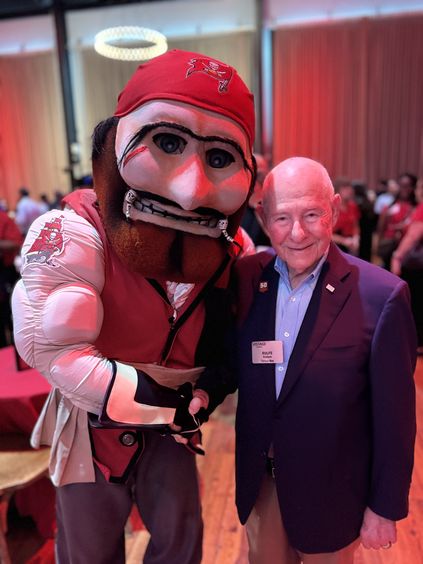
Rolfe celebrates his birthday with Captain Fear, a bearded, muscular pirate and the Tampa Bay Bucs' official mascot.
And then—the Tampa Bay Buccaneers Cheerleaders and the Bucs Drum Corp. escorted me into a party room with 350 celebrants from nearly every chapter of my life. It was fun, yet humbling. Reminded me that leadership, friendship, service and community are built one relationship at a time.
JB: You're now 96, what's your advice for living a long, happy life?
RA: Stay useful. Keep your mind working and curiosity alive. Keep good people around you. Do something tomorrow that matters. Don't spend too much time admiring what you already did. Fulfillment comes from contribution. Have a reason to: Get up. Learn. Listen. Be of service to another.
Be grateful for what you've achieved. But don't become passive. Gratitude shouldn't make you sit still. It should inspire you to give more. I've had extraordinary people in my life. The best way to honor them, is knowing I must keep showing up for others.
JB: Malcolm Forbes said, "As you get older, don't slow down. Speed up. There's less time left!" What still drives you?
RA: Unfinished work. There's always someone facing a hard decision. A leader who needs to think more clearly. There's always a room where the right question changes the conversation. That still excites me.
Am also driven by curiosity, challenge and people. I like working with leaders because leadership is never finished. You never know it all. If you think you do, you're about to make a very expensive mistake.
Leaders I enjoy most, are those still learning. They're accomplished, not closed. Confident, not arrogant. They ask, "What am I missing?"
JB: What are the qualities of a great leader?
RA: The qualities haven't changed. The tools, speed and noise have changed. A great leader creates clarity. People can't follow confusion. If the mission is vague, work will be scattered.
A great leader has courage—the willingness to make tough decisions, have hard conversations and stand by a principle when it's easier to avoid the issue.
A great leader has humility. It isn't about being the smartest. Often, the best thing a leader does, is ask the question no one else has. A great leader also finishes. Many start well. Fewer finish well. A leader who finishes builds trust. A leader who doesn't finish shows and teaches—commitments are optional.
JB: You're a West Point grad, served in the military for 21 years, including two combat tours in Vietnam, commanded an infantry brigade and retired as a Lieutenant Colonel in the U.S. Army. What valuable lessons did you learn from your military service?
RA: West Point taught me discipline, standards and the importance of closing the gap between intention and execution. The Army taught me the weight of responsibility.
In command, your decisions affect real people in real time. That changes the way you think. You learn clarity isn't a luxury. It's a necessity. You learn calm is contagious. So is panic. You learn people watch what you do under pressure far more closely than they listen to what you say in comfort.
Also learned plans matter, but the plan isn't the point. Thinking is the point. Conditions change. Equipment fails. People surprise you. The briefing doesn't cover what actually happens.
At some point, you stop waiting for certainty and figure it out. It doesn't mean being reckless. It means using your training, judgment, values and the people around you to find the next right step.
JB: How the heck did you move the Army-Navy Football Game from Philadelphia, PA to Pasadena, CA in 1983? And why?
RA: Short answer: persistence, relationships and a high tolerance for hearing, "No." People forget how bold that was at the time. Army-Navy belonged to Philadelphia in most people's minds. It was tradition. And tradition has a loud voice.
But I believed the game belonged to the whole country. There were military families, active-duty personnel, veterans, academy graduates and supporters on the West Coast who never had the opportunity to experience the game in-person.
Pasadena and the Rose Bowl gave us a large and symbolic stage to say, "This game is America's game!"
Moving it required building-the-case, finding allies, overcoming objections and refusing to be discouraged too early. At first, people say "No" because it's easier than rethinking what has always been done. If you believe an idea has merit, don't be offended by the first "No." Keep improving your argument until people see what you see.
JB: Since time is finite, how do you increase its value?
RA: Become more intentional. Do fewer things better. Protect time to think. Say "No" sooner. Finish what matters. Spend time with people who sharpen you, not just agree with you.
Time becomes more valuable when you stop treating everything as equal. It's not! Some conversations, decisions and relationships matter more. Some work changes the future. Other work merely fills the calendar. A full calendar isn't the same as a meaningful life.
JB: What's the biggest challenge leaders face today?
RA: They're drowning in data, emails, meetings, opinions, alerts and urgency. Many are very busy and not as effective as they could be. They're reacting all day and calling it leadership. Reacting isn't leading.
I help leaders slow down long enough to think. Simple, but not easy. A good question cuts through noise. I'll ask, "What are you missing?" or "What decision are you avoiding?" or "What would you do if I wasn't available?" These questions create space. Enabling leaders to discover the perceived issue isn't the real issue. My job isn't to give all the answers. It's to help leaders think clearly enough to find the right answers. Then hold them accountable for acting on it.
JB: How do you do that?
RA: Accountability begins before the work starts. Too many think it's what happens after something goes wrong. That's blame or consequence. Real accountability begins with defined expectations and clarity: who owns what, by when and to what standard. At the end of a meeting or conversation ask, "What are we each committing to? By when?" {Jeff's note: for decades I've encouraged clients to execute the Success Formula: "I will do X (behavior or action) by Y (date)." It's simple and it works!}
Then follow-up. Not to micromanage, but to make progress visible early enough to help. If you wait until the deadline for the truth, you've built a reporting-system, not an accountability-system.
Accountability should be direct, specific, timely. Not emotional. It's how serious people work together. Plus, the leader models it first. If you don't keep your commitments, don't be surprised when others treat theirs casually.
JB: Where does your "can do" attitude come from?
RA: Being raised when complaining didn't solve much. Then being shaped by West Point and the Army. You didn't always have: the resources you wanted, the perfect plan or ideal conditions. But the job still had to be done. 
Over time, "can do" became less about optimism and more about responsibility. A "can do" attitude doesn't mean pretending everything is easy. It means refusing to make "difficulty" the excuse for inaction. It requires looking at the situation honestly and asking, "What can we do with what we have?"
That mindset has helped me in; the military, business, community leadership and coaching CEOs. The world rarely hands you perfect circumstances. Waiting for them is a good way to waste your life.
JB: In your book, Start Everything Finish Nothing, you focus on strategies for overcoming distractions. Like...?
RA: Six things:
1. Define the finish line before you start. Too many start projects with enthusiasm but no clear definition of completion. If you don't know what "finished" looks like, don't be surprised when you never get there.
2. Limit priorities. Most don't have a time-problem. They have a subtraction-problem. They keep adding without removing.
3. Protect your time to think. If your calendar is all reactive, you and your business will be reactive.
4. Don't start a major new initiative until another one is completed or closed. This saves individuals and organizations from wasted energy.
5. Ask what you should stop doing.
6. Make completion visible. Celebrate those who made it happen. People repeat what's rewarded.
JB: You encourage others to have a "tag line" — a clever descriptive way to quickly tell their story or identify what makes them unique. What's yours?
RA: "Figure it out." It means don't wait helplessly for perfect conditions. Don't make excuses or assume someone else will solve it. Think. Ask. Learn. Decide. Act. Adjust. Keep going.
It reflects how I think about leadership, business and life. There's no script for every situation. You'll face things you didn't expect. The plan changes. The market shifts. People-problems become more complicated. So...
Figure it out! Help others figure it out too.
JB: What's one thing any individual can do to create an immediate and long-term positive impact?
RA: Do what you said you were going to do. Return the call. Keep the commitment. Finish the project. Tell the truth. Follow-up. Be on time. Make hard decisions. Send thank-you notes. Reliability is your competitive advantage.
This applies in business, family, friendship, leadership and life. When people can count on you—trust compounds.
Nothing complicated. Start with your next commitment. Keep it. Keep the next one. Over time, that becomes who you are. Am confident, you'll be able to: Figure it out!
To discover more ways Rolfe can help you "figure it out" to maximize results, please take a peek at:
RolfeGArnhym
• • • • •
Since 2011, Mike Goor, Founder, President & CEO of CLC / Contract Leasing Corp. has had an ongoing relationship with Jeff. Mike relies on Jeff's counsel, guidance and ability to continually help him and his CLC team drive results.
In July, 2026 Mike wrote:
“Jeff is a consummate professional, always willing to help us solve a problem and achieve our objectives. His sales methodology is part of our CLC Sales Manual and our reps use his techniques and strategies daily.
Jeff's approach to business is refreshing. I've worked with him over decades. I value his sincere interest in our success, willingness to listen to our concerns and then offer recommendations and solutions.
He's the epitome of preparation. It's the only way I've experienced working with him. He takes his work (not himself) seriously. And holds himself and his deliverables to a very high standard. He goes the extra mile without being asked and is truly focused on our results.
I also believe Jeff was born to do what he does. Plus, being trained as a lawyer gives him a unique skill set and level of professionalism that sets him apart.
I trust Jeff and the value he brings to me and our CLC team.”
• • • • •
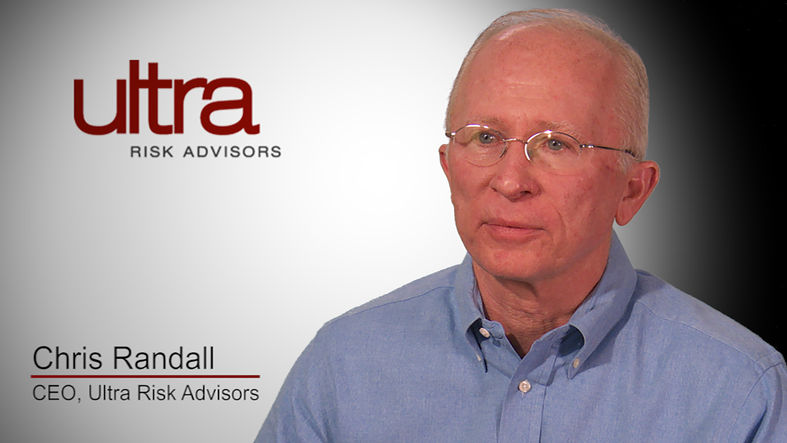
Want to see how Jeff Blackman helped another client drive results? Please take a peek at this video where Chris Randall, CEO of Ultra Risk Advisors talks about Jeff's positive, powerful impact on his team. Including, "...revenue is up over 35%!"
To explore how Jeff can help you and your team drive results—with speaking, training, coaching, consulting and ongoing reinforcment—in-person or virtual, please contact Sheryl Kantor at: [email protected] or 847.998.0688
|